Six Sunice SL grades are stocked here, and their names are built two different ways. Four carry the ISO class in the name: SL-22S, SL-32S, SL-68S and SL-100S. Two carry a round number instead: SL-170T and SL-220T. One of those two round numbers does not match the class on the drum.
All six are synthetic polyol ester refrigeration oils from Japan Sun Oil, and all six fall inside the ISO band stated against them.
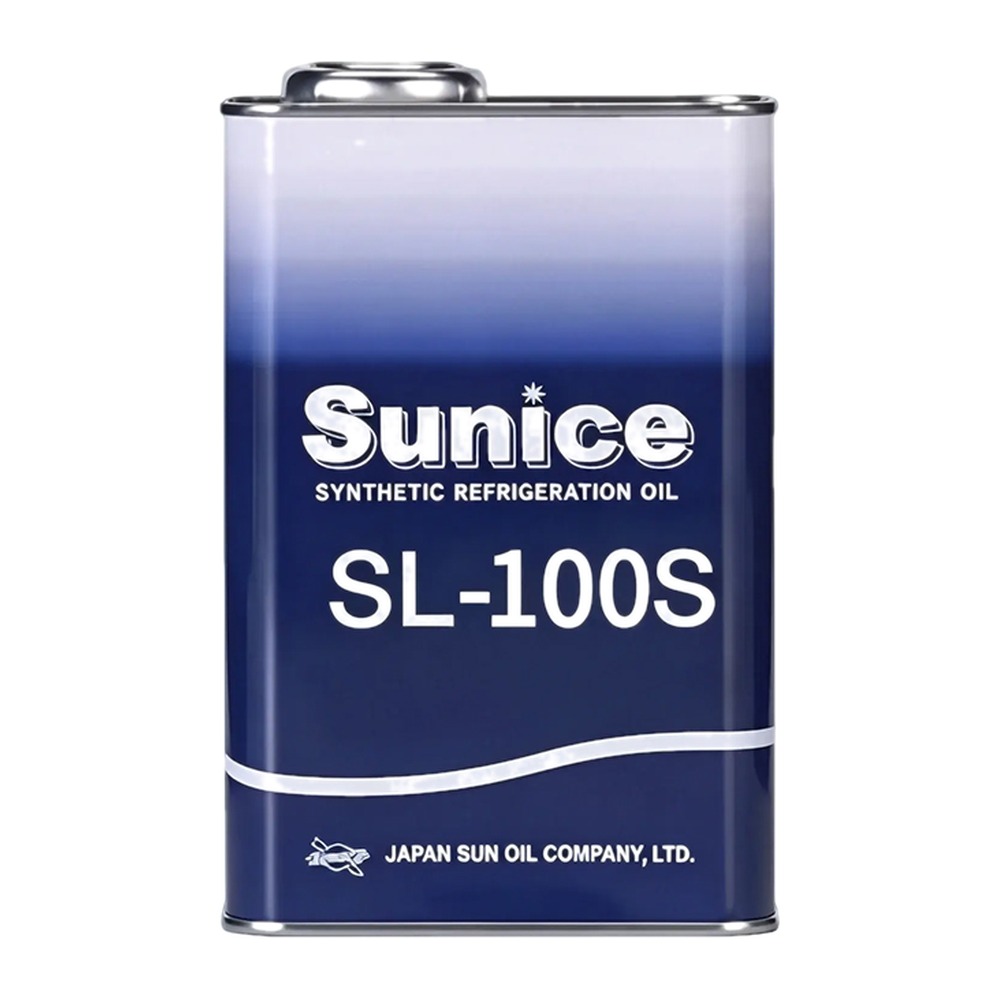
The four S grades are named after the class they sit in. SL-22S measures 22.5 cSt and the VG 22 band runs from 19.8 to 24.2. SL-32S measures 32.3 inside 28.8 to 35.2. SL-68S measures 66.6 inside 61.2 to 74.8. SL-100S measures 98.1 inside 90 to 110.
For these four, the number and the class agree, and a buyer quoting either the grade or the ISO class is asking for the same fluid.
SL-220T measures 216.0 cSt, which sits inside the VG 220 band of 198 to 242. The name rounds the measurement up to the class, and the class holds.
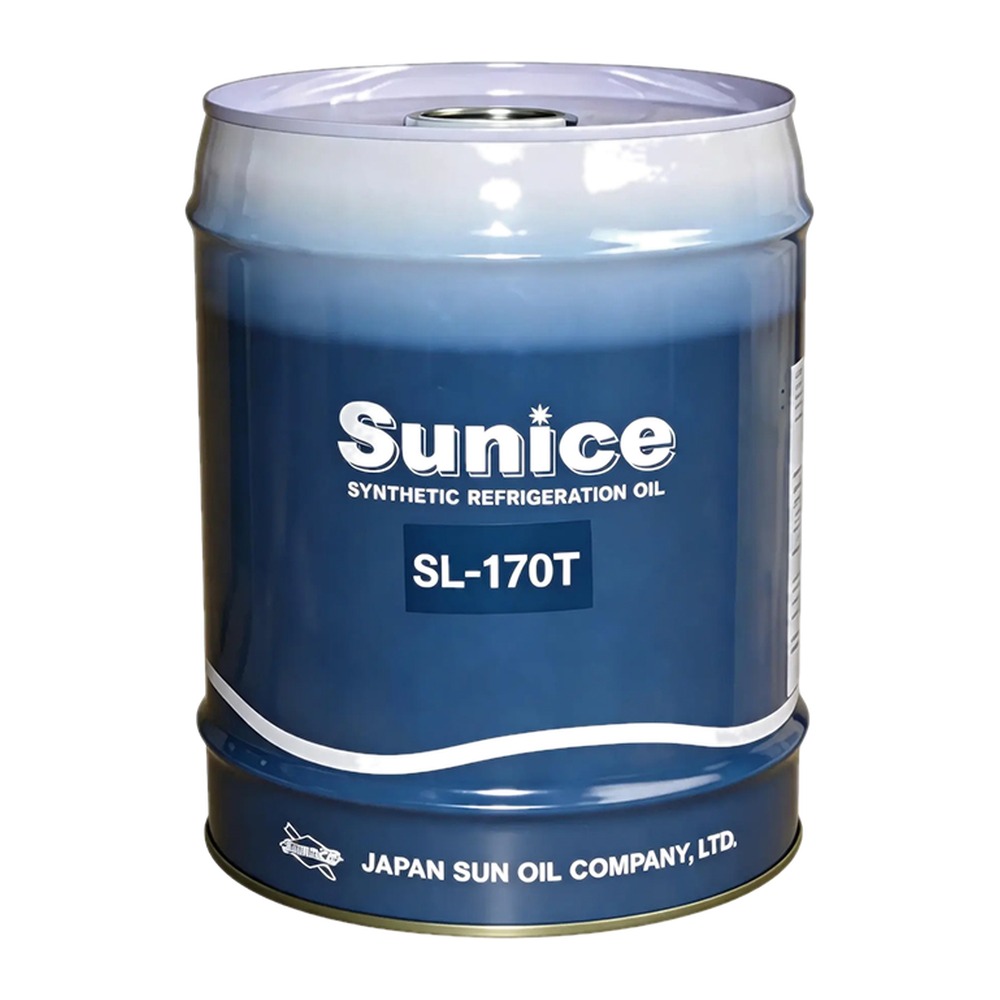
SL-170T measures 161.0 cSt. The VG 150 band runs from 135 to 165, so the measurement sits inside VG 150, and the grade is classified as ISO VG 150. The number in the name is 170, which is not an ISO class at all: DIN ISO 3448 has no VG 170, and the gap between the VG 150 ceiling of 165 cSt and the VG 220 floor of 198 cSt has no band in it.
So on this line a buyer who reads 170 as a viscosity class is looking at a fluid that is not in that class, while a buyer who reads VG 150 is holding the right grade.
Sort the six by viscosity and two of the published figures refuse to move in step.
Pour point runs −50, −35, −40, −35, −30 and −27.5 °C. SL-68S, at −40 °C, pours colder than SL-32S at −35 °C, which is a full grade thinner. A plant moving from 32S to 68S for more film also gains 5 K at the cold end.
Flash point runs 212, 230, 254, 234, 280 and 286 °C. SL-100S, at 234 °C, is 20 K below SL-68S at 254 °C, and SL-100S is the thicker of the two.
Neither figure can be interpolated from the grade number. A selection that assumes thicker means higher flash point gets the wrong answer twice on this line, once at 100S and once at 68S.
The series covers a wide viscosity span from one base fluid, so the choice between grades is a choice of thickness rather than of chemistry. Miscibility with the refrigerant holds across the range because the base oil does not change.
The cold end is where the pour point decides. SL-22S at −50 °C is the grade for the lowest evaporating temperatures, and each step up the range gives away cold-end performance: 10 K to reach 68S, and at least 22.5 K to reach 220T.
The warm end is where the 100 °C figure and the flash point decide. SL-220T holds 19.0 cSt at 100 °C against 4.1 cSt for SL-22S, and its flash point of 286 °C is the highest in the six.
A system that runs cold and a system that runs hot therefore sit at opposite ends of the same table, and the middle of the range is where most screw machines land.
Put numbers on the two ends. Between SL-22S and SL-220T the 40 °C viscosity grows by a factor of 9.6, the 100 °C viscosity by 4.6, the pour point moves at least 22.5 K and the flash point 74 K. The spread at 40 °C is twice the spread at 100 °C, which is the ordinary behaviour of a single base oil and the reason the grade matters most at the cold end of a system.
The two ends also differ in which figure runs out first. At the thin end the constraint is the evaporating temperature against a pour point of −50 °C. At the thick end it is the condensing temperature against a flash point of 286 °C and a 100 °C viscosity of 19.0 cSt. Neither end is decided by the number in the grade name.
Each grade has a partner in the QISHANR QSL ester line, and the six pair up one to one.
| Sunice grade | 40 °C | QISHANR equivalent | 40 °C |
|---|---|---|---|
| SL-22S | 22.5 cSt | QSL-22H | 18.9 cSt |
| SL-32S | 32.3 cSt | QSL-32H | 33.3 cSt |
| SL-68S | 66.6 cSt | QSL-68H | 66.6 cSt |
| SL-100S | 98.1 cSt | QSL-100H | 96.5 cSt |
| SL-170T | 161.0 cSt | QSL-170H | 170 cSt |
| SL-220T | 216.0 cSt | QSL-220H | 215 cSt |
The pairs are close but not interchangeable by number alone. SL-22S at 22.5 cSt against QSL-22H at 18.9 cSt is a 3.6 cSt gap at the thin end, where 3.6 cSt is a large fraction of the total. The 68 grade is the closest match of the six, at 66.6 cSt on both sides.
The 170 pair runs the other way from the naming on the Sunice side: SL-170T is 161.0 cSt while QSL-170H is 170 cSt, so the grade that names 170 in the Sunice line is the thinner of the two, and the grade that names 170 in ours is the thicker.
The Sunice SL series runs from 10 cSt to 320 cSt at 40 °C. Six grades are stocked here, which is the middle of that span rather than the whole of it.
That matters when an enquiry names a grade outside the six. A 10 grade or a 320 grade exists in the series; it is simply not one of the rows in the table above, and it is not quoted from stock.
Density at 15 °C rises with the grade: 0.951, 0.956, 0.960, 0.974, 0.968 and 0.976. The pattern is almost monotonic, with SL-170T at 0.968 the one step out of order against SL-100S at 0.974.
Where a charge is filled by weight rather than by volume, the spread from 0.951 to 0.976 is a 2.6 percent difference in mass for the same drum.
The band a grade sits in has two edges, and the distance to each one is what a batch tolerance has to cover.
| Grade | Measured | Band | Margin to floor | Margin to ceiling |
|---|---|---|---|---|
| SL-22S | 22.5 cSt | 19.8 to 24.2 | 2.7 cSt | 1.7 cSt |
| SL-32S | 32.3 cSt | 28.8 to 35.2 | 3.5 cSt | 2.9 cSt |
| SL-68S | 66.6 cSt | 61.2 to 74.8 | 5.4 cSt | 8.2 cSt |
| SL-100S | 98.1 cSt | 90 to 110 | 8.1 cSt | 11.9 cSt |
| SL-170T | 161.0 cSt | 135 to 165 | 26.0 cSt | 4.0 cSt |
| SL-220T | 216.0 cSt | 198 to 242 | 18.0 cSt | 26.0 cSt |
Two of the six sit close to an edge. SL-22S is 1.7 cSt below the VG 22 ceiling, and SL-170T is 4.0 cSt below the VG 150 ceiling. The other four have at least 5 cSt of room on the tighter side.
That is the arithmetic behind the naming difference. The two tight grades are the two whose names do not equal their class, and in the 170 case the name points at a class the fluid is nowhere near.
SL-68S is also sold as T-68, and the two designations describe the same 66.6 cSt fluid. The comparison between them is covered in the T-68 and SL-68S article, and the point that matters here is that the 68 grade appears twice in a stock list that is otherwise one row per grade.
No. It measures 161.0 cSt at 40 °C, inside the VG 150 band of 135 to 165, and the grade is classified as ISO VG 150. ISO 3448 has no VG 170 class.
SL-22S, SL-32S, SL-68S and SL-100S. The two T grades carry a rounded number instead, and SL-220T happens to match its class while SL-170T does not.
The published pour points are −40 °C for SL-68S and −35 °C for SL-32S. The figures come from each grade's own specification, and they do not follow the viscosity order.
SL-220T at 286 °C, with SL-170T next at 280 °C. SL-100S at 234 °C is lower than both SL-68S and SL-170T despite being thicker than 68S.
Yes. All six are synthetic polyol ester oils from Japan Sun Oil, so the difference between them is viscosity rather than chemistry.
Copyright & Citation Notice. This article is original content published by Qishanr Lubricants (qishanrlubricants.com). Viscosity, pour point, flash point and ISO class statements are the published values for each Sunice SL grade. Quotation of up to 200 words is permitted with attribution and a link to this page. Reproduction in full requires written permission.