Three BITZER grades carry a number in the name, and the three numbers do not measure the same thing. B5.2 at 40 °C is 39 cSt. B100 is 94.0 cSt. B150SH is 168.0 cSt. Only one of the three names is close to the figure underneath it.
All three are specified for R22 machines, and the split between them is the compressor type rather than the refrigerant.
The number in B5.2 is not the 40 °C viscosity. The grade measures 39 cSt at 40 °C and 4.9 cSt at 100 °C, and 5.2 sits next to the second figure, not the first.
The 39 cSt figure also falls between two ISO bands. VG 32 ends at 35.2 cSt and VG 46 starts at 41.4 cSt, so the grade carries no class number, which is what the BITZER documentation states for it.
B5.2 is the standard charge for BITZER scroll compressors on (H)CFC refrigerants, R22 among them. The pour point is −40 °C, the flash point 190 °C and the density 0.88 at 15 °C.
The published curve is steep: 122 cSt at 20 °C, 39 cSt at 40 °C and 4.9 cSt at 100 °C. Over 80 kelvin the fluid loses 96 percent of its viscosity, which is the behaviour a small hermetic scroll needs to keep oil moving at the cold end.

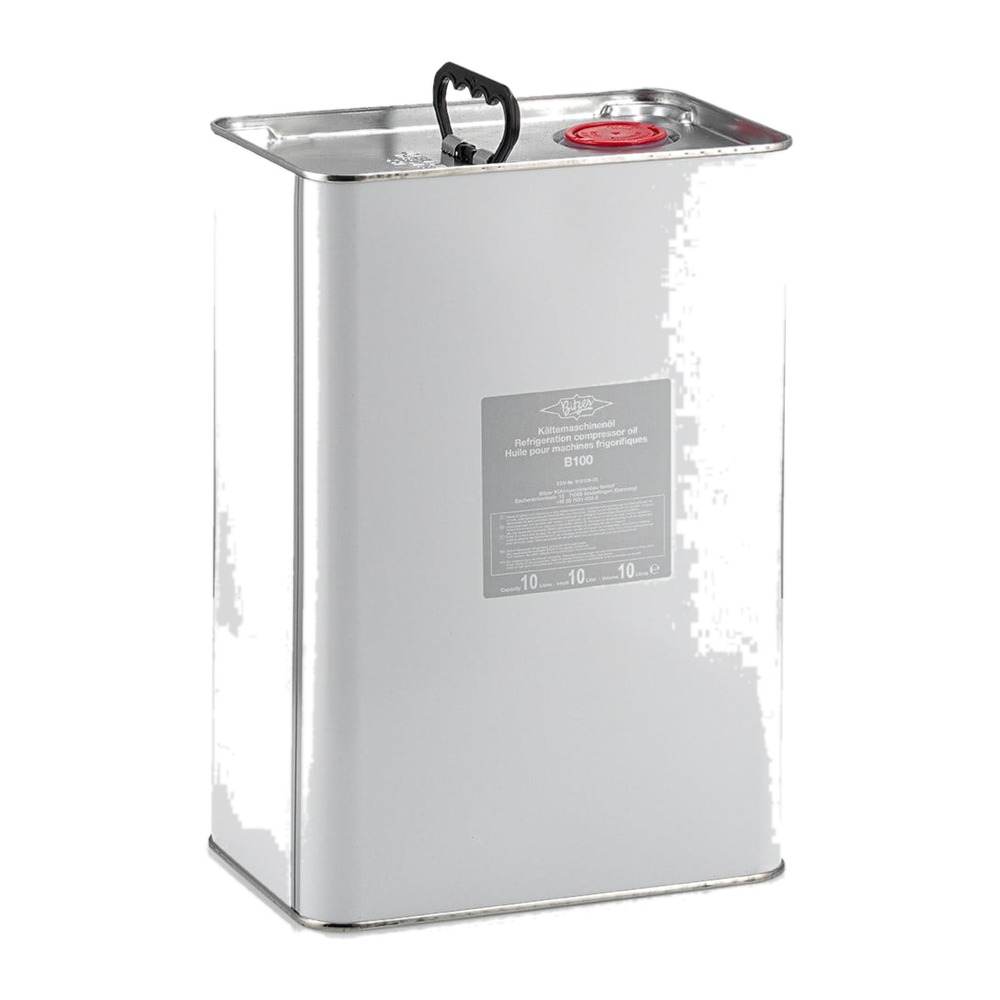
B100 is the grade where the name and the measurement are closest. It measures 94.0 cSt at 40 °C, inside the VG 100 band that runs from 90 to 110 cSt, and the BITZER documentation states that it carries an ISO class number.
The name sits six centistokes above the measurement and lands exactly at the middle of the band. A buyer writing B100 on an order and a buyer writing ISO VG 100 are asking for the same fluid, which is not true of the other two grades in this article.
B100 belongs to the screw compressor group, alongside B170 and B320, and is specified for R22. Its density at 40 °C is 852 kg/m³.
The 150 in the name does not match either measurement. B150SH is 168.0 cSt at 40 °C and 20.0 cSt at 100 °C.
The 40 °C figure is above the VG 150 band, which ends at 165 cSt, and below the VG 220 band, which starts at 198 cSt. The BITZER documentation states that no ISO class number applies to the grade, and the measurement supports that: there is no band for 168 cSt.
So the name is a designation rather than a viscosity, and a buyer who reads 150 as VG 150 is looking for a band the fluid is not in. The 18 cSt difference is small enough to look like rounding and large enough to sit outside the class.
B150SH sits in the same screw compressor group as B100, with a density of 990 kg/m³ at 40 °C.

B100 and B150SH publish a full temperature series, and it shows how differently the two thin out.
| Temperature | B100 | B150SH |
|---|---|---|
| 40 °C | 94.0 cSt | 168.0 cSt |
| 50 °C | 53.0 cSt | 100.0 cSt |
| 60 °C | 32.3 cSt | 70.0 cSt |
| 70 °C | 21.1 cSt | 48.0 cSt |
| 80 °C | 14.6 cSt | 34.0 cSt |
| 90 °C | 10.5 cSt | 26.0 cSt |
| 100 °C | 7.9 cSt | 20.0 cSt |
At 100 °C, B100 holds 8.4 percent of its 40 °C figure and B150SH holds 11.9 percent. B5.2 publishes two points, 39 cSt at 40 °C and 4.9 cSt at 100 °C, which is 12.6 percent.
The gap between 40 and 100 °C is therefore widest on B100, the grade whose name is closest to its 40 °C measurement. Name and curve are separate properties, and the curve is what a machine at a given evaporating and condensing temperature actually sees.
The three grades also differ in density, which matters wherever a charge is measured by weight rather than by volume.
B5.2 is 0.88 at 15 °C. B100 is 852 kg/m³ at 40 °C. B150SH is 990 kg/m³ at 40 °C, the heaviest of the three by a wide margin.
A drum weighed on a scale and a drum filled to a mark do not contain the same mass, and the difference between 852 and 990 is large enough to matter when a service is filling from a bulk container into a machine whose charge is written in kilograms.
Read together, the three grades show three different naming habits inside one series. B5.2 points at the 100 °C figure. B100 points at the 40 °C figure and lands inside the matching ISO class. B150SH points at neither figure and carries no class.
That means the name cannot be used as a viscosity in any of the three without checking. The habit that works is to quote the measured 40 °C figure from the data row alongside the grade, which is also the figure a certificate of analysis reports.
It also means that substituting one B grade for another on the basis of the number is unsafe at both ends: 5.2 to 100 looks like a large step and is larger still, 39 to 94 cSt, while 100 to 150 looks like a moderate step and is 74 cSt, from 94.0 to 168.0.
At 100 °C the three are closer together than their names suggest: 4.9, 7.9 and 20.0 cSt. A machine that runs hot sees a narrower spread than the 40 °C figures imply, and a machine that runs cold sees a wider one. Neither view is available from the grade name.
The documentation behind these three pages names the split explicitly. B5.2 is listed for piston compressors and is the standard charge on scroll compressors, both on R22, while the BSE grades cover 404A, 134a and the other HFC refrigerants. Screw compressors on R22 take B100, B170 or B320.
That is the group these three grades belong to, and it is where the names diverge. B5.2 serves one machine type on one refrigerant; B100 and B150SH serve a screw group where several grades sit side by side, and the number distinguishes them from each other rather than describing a class.
A plant running both a scroll and a screw on R22 is therefore holding two different B grades for the same refrigerant, and the difference between them is 39 cSt against 94.0 cSt.
The B series is not one family. B320SH is a complex ester grade in the KC oil group, specified for R22 compact screws, and it is documented separately from the three grades here. The BSE line is the polyol ester range for HFC, HFO and CO2 duty, from BSE32 to BSE170, and it is covered in the BSE selection guide.
So an R22 plant can meet three different fluids depending on the machine: B5.2 on a scroll, B100 or B150SH on a screw, and B320SH where the compact screw specification calls for it. The refrigerant is the same in all three cases; the compressor decides.
It measures 39 cSt at 40 °C and 4.9 cSt at 100 °C. The number in the name is close to the 100 °C figure.
By measurement, yes. It is 94.0 cSt at 40 °C, inside the VG 100 band of 90 to 110 cSt, and the BITZER documentation states that the grade carries an ISO class number.
It measures 168.0 cSt at 40 °C. The VG 150 band ends at 165 cSt and VG 220 starts at 198 cSt, so the grade falls between the two and no class applies.
B5.2, which is the standard charge for BITZER scroll compressors on (H)CFC refrigerants including R22. B100 and B150SH belong to the screw compressor group.
No. B5.2 is 39 cSt, B100 is 94.0 cSt and B150SH is 168.0 cSt, so the name does not track a single viscosity across the three.
Copyright & Citation Notice. This article is original content published by Qishanr Lubricants (qishanrlubricants.com). Viscosity, density, pour point, flash point and ISO class statements are taken from the BITZER documentation for B5.2, B100 and B150SH. Quotation of up to 200 words is permitted with attribution and a link to this page. Reproduction in full requires written permission.